
The Natural History Museum Vienna is celebrating its 150th anniversary this year with a special exhibition. From April 28th, the exhibition "Good Collecting – Bad Collecting" will illuminate the history of the museum, the passion for collecting, the joy of discovery and research, but also the darker sides of collecting and collections.
On April 29, 1876, Emperor Franz Joseph I legally founded the Natural History Museum Vienna with his signature, and on April 30, 1876, he appointed the geologist Ferdinand von Hochstetter as its first director. At that time, the museum building on Vienna's Ringstrasse was already well under construction – the grand opening finally took place in August 1889.
Today, the museum houses one of the world's most important natural history collections, with more than 30 million objects. The Natural History Museum Vienna (NHM Vienna) is a unique archive for the origin and development of the Earth and life. It documents the history and structure of our planet, showcases the diversity of life on Earth, and provides insights into human evolution. Like almost no other natural history museum, it explores the entire spectrum of nature, past and present, using biological, geological, paleontological, mineralogical, anthropological, prehistoric, and cultural-historical objects.
The 150th anniversary of the Natural History Museum Vienna (NHM Wien) is now an occasion for a critical review of its own history. This review contrasts the passion for collecting and the joy of discovery and research that continue to drive its scholars, with the darker aspects of collecting and collections.
Some objects appear Janus-faced, scientifically unique yet burdened by their problematic acquisition history. Were the famous expeditions of the 19th century an honorable attempt to expand knowledge and acquire exotic objects for the imperial collections—or was a colonial agenda the true motivation? How were objects acquired illegally during the Nazi era dealt with, and how should pieces that entered the collections through ethically questionable means be assessed? Depending on one's perspective, an object functions as a dispassionate repository of scientific information or as a manifestation of dubious collecting methods. Depending on the viewpoint, a collection object may be materially valuable yet of little scientific interest. Conversely, an inconspicuous, tiny insect can be a unique specimen whose loss is priceless.
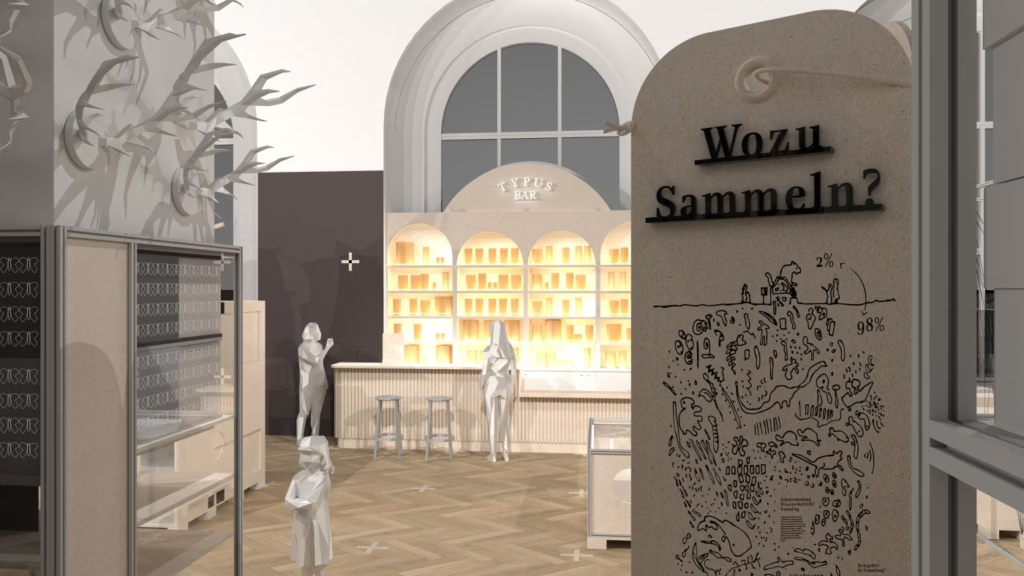
This ambivalence, manifested in the Natural History Museum Vienna and its collections, forms the exhibition's central theme and shapes its architecture and design. The design team from breadedEscalope and Benedikt Haid deliberately adopted unexpected perspectives to illuminate the collections and selected objects from unfamiliar angles and recontextualize them. The result is an exhibition that breaks with conventional viewing habits and expectations, and despite the complex themes, allows the curators to sense their deep and often affectionate connection to "their" collections. For it is only through the scholars and the application of new methods that new questions continually arise, revealing the significance of the collections for our modern knowledge society.
The museum's galleries explore the history of the institution since its beginnings under Maria Theresa and Francis I Stephen of Lorraine, highlighting iconic moments in the collection. From the first collection catalogues and the founding charter of the Natural History Museum Vienna signed by Emperor Franz Joseph I, to a historic spittoon from one of the exhibition halls, the exhibition spans to handprints left by climate activists, vividly illustrating the societal changes of the past 150 years.
Another focus of the exhibition is the other locations of the Natural History Museum Vienna: the Danube Floodplains National Park Institute in Petronell, the Archaeological Research Center in Hallstatt, and the Pathological-Anatomical Collection in the so-called Fool's Tower in Vienna. In the 20th and 21st centuries, artists increasingly engaged with the museum and its collections, opening up entirely new perspectives. The creative spectrum of works, curated as a separate gallery within the exhibition, ranges from painting and photography to performance and the use of artificial intelligence.
The two main rooms are entirely dedicated to the theme of collecting in all its complexity and ambivalence. The grid-like layout of one room reflects the idea of ordering and systematizing. Individual thematic complexes are assigned to the grid nodes, their diversity illustrating the complexity of the collections. The other room abandons this strict structure and, quite literally, encourages a shift in perspective through a selection of iconic objects.
The digital museum marks the end – or the beginning – of the tour. Here, high-resolution 3D models of collection objects are projected through interactive animations, raising the question of whether the digital object can be an adequate substitute for "the real thing" and what this might mean for the "museum of the future".