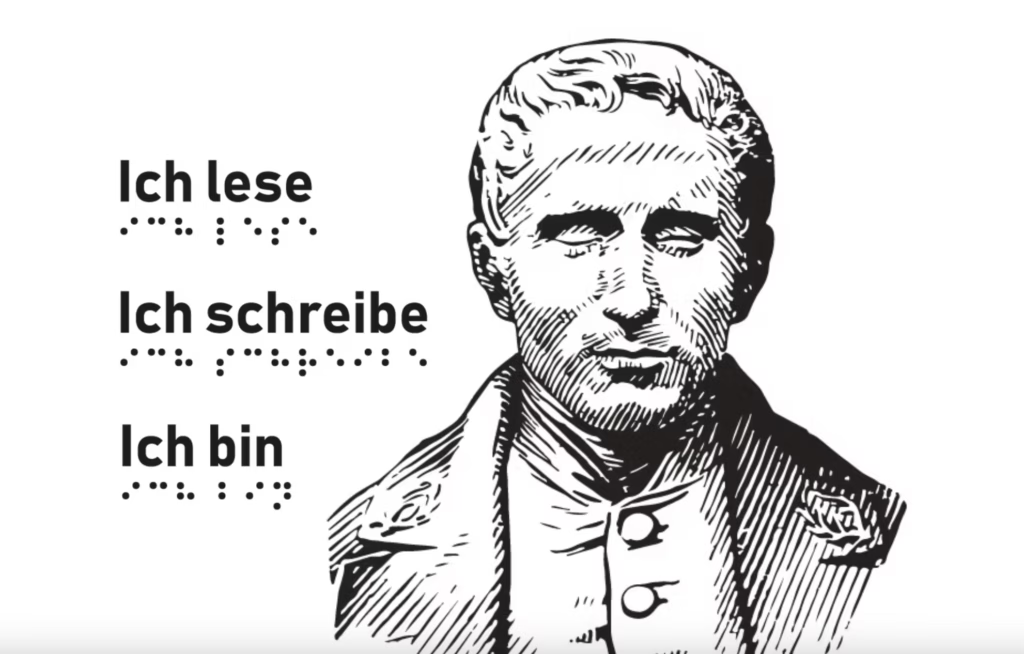
A six-point system is revolutionizing the education and participation of blind people worldwide: Braille, invented in 1825 by Louis Braille, celebrated its 200th anniversary in 2026. An exhibition compiled for this occasion by the Austrian Federal Institute for the Education of the Blind in Vienna has now reopened and been extended until Easter 2026.
The exhibition pays tribute to the life's work of Louis Braille and shows the importance of his invention for education, culture and self-determination – from its beginnings to the present day.
Louis Braille (1809–1852) became completely blind at the age of five and soon after began to consider how he could continue to read independently. He experimented with pieces of leather and simplified and optimized existing writing systems he had learned at the school for the blind. By the age of 16, he had completed his system—in the form we still know it today. However, it would be decades before his writing system became widely adopted.
The system, which functions similarly to a computer using binary, can represent 64 different characters with just six dots arranged in two vertical rows of three dots each. This makes it translatable into any language, and it has long since entered the digital age.
Exhibition „Louis Braille – I read I write I am“
Schellinggasse 13, 1010 Vienna
Thurs, Fri 10am – 6pm & Sat 2pm – 6pm (except on public holidays)
Group tours (duration approx. 1.5 hours) are only available with prior registration at info@louis-braille.com or 01/728 08 66-501
Admission is free; voluntary donations are welcome. The exhibition is complemented by a digital component. Info guide