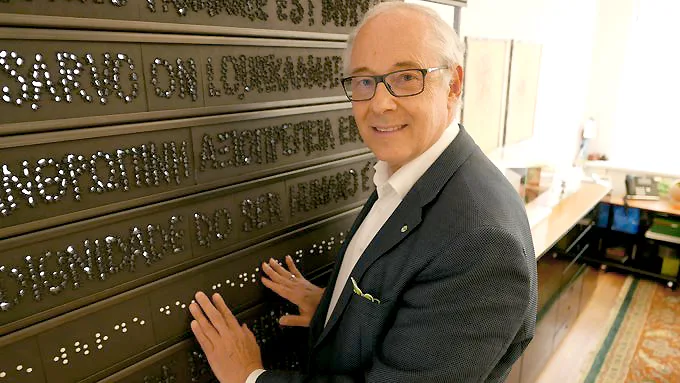
Interview with Martin Essl, who, as an entrepreneur, has experienced the benefits of employing people with disabilities. As the founder and initiator of the Zero Project, he is now committed to their full participation in society.
Museum Guide: Why do we need inclusive art education?
Martin Essl: Because it's a legally enshrined right. By ratifying the UN Convention on the Rights of Persons with Disabilities in 2008, Austria also committed itself to enabling people with disabilities to fully participate in all social achievements. And this naturally includes museums, which are largely publicly funded.
Museum Guide: What does an inclusive museum look like to you?
Martin Essl: Inclusive art creates spaces for encounters and shared experiences for people with and without disabilities. Art broadens perspectives. This must be made an option, but not compulsory. Inclusive art education should be available to all people—with and without disabilities.
Museum Guide: Does that mean that inclusive art education also enriches the lives of people without disabilities?
Martin Essl: We all have the need to experience things with as many of our senses as possible, so that these experiences stay with us much longer. This can be seen in sculptures in public spaces, which are completely smooth in some places because people also grasp them. And why shouldn't the vibration of a bass also be exciting for a hearing person?
Museum Guide: To what extent do the actions of climate activists hinder the willingness of museums to make their works accessible in this way?
Martin Essl: Of course, a work of art must be preserved, but there are a number of options and technologies available to make selected objects inclusively accessible. It's certainly the case that people who visit a museum don't remember every work on display.
Museum Guide: Is it even possible to make any art inclusive?
Martin Essl: As part of the Zero Project, we are also exploring innovative approaches to inclusive art education. These examples demonstrate what is already possible today and are intended to serve as inspiration – for museums, but also for the community of people with disabilities, who can recognize which new developments are taking place where.
| About the Zero Project Each year, more than 1,000 experts from the global Zero Project network select the most innovative and effective "practices and policies" on one of the four core themes of the UN Convention on the Rights of Persons with Disabilities: accessibility, employment, education, independent living, and political participation. Information and communication technology (ICT) is a regular focus of the Zero Project's work, as is the search for best practices in inclusive arts education. These calls for nominations annually generate around 500 submissions from over 100 countries. 70-80 winning projects are presented at the annual Zero Project Conference at UN Headquarters in Vienna and in the accompanying Zero Project Report. Details and further information on activities in Austria can be found at zeroproject.org. |